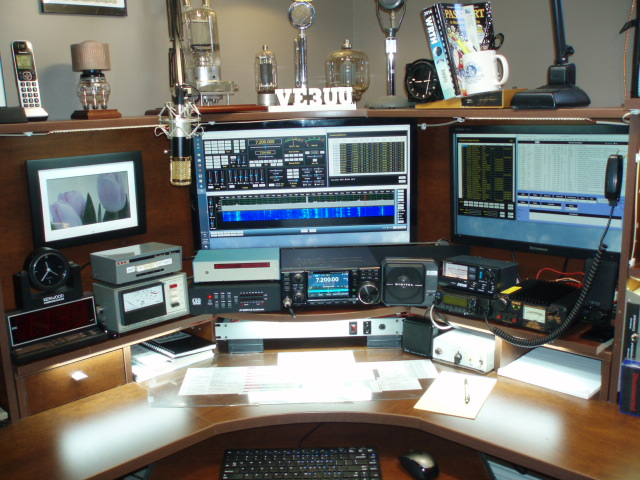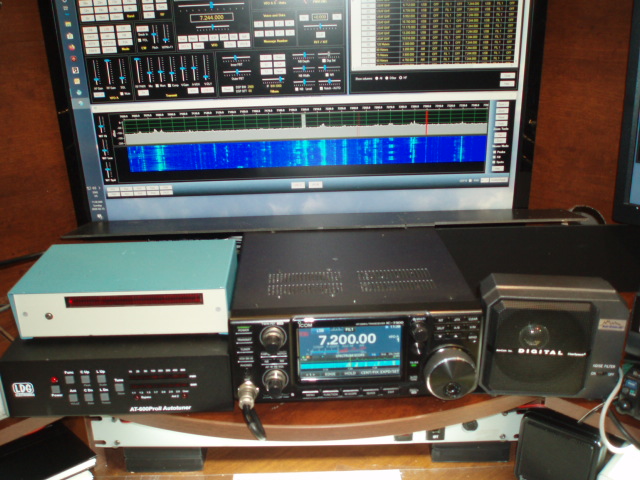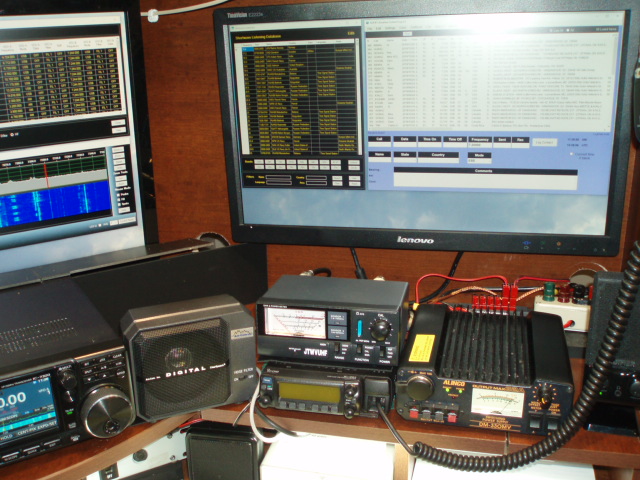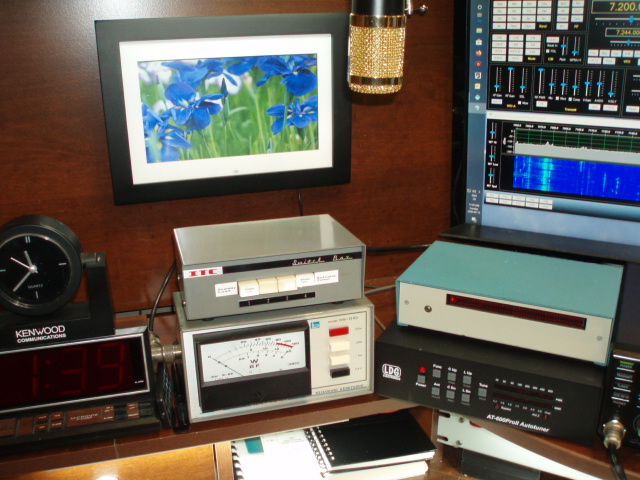
Welcome!
navigation graphic Welcome
Welcome to amateur radio station VE3UU, located in the country, 6 KM outside of Carp Ontario, a suburb of Ottawa, which is Canada's capital.

Until it got amalgamated into Ottawa, Carp was a sleepy little village of 900 people that was famous for a 100,000 square foot, four-story building that you couldn't see. You can learn more about that by visiting the Secret Bunker section of this site.

Click on the links below to visit the various section of this page.


VE3UU's Chief Operator

The Chief Operator is Brian Jeffrey. I was first licensed as VE3EBF in August 1957 and held onto that call until I went up to the Arctic (see the section on the DEWLine) where I held the call VE8SK. Upon my return I was licensed as VE3BCJ and I held onto that call for many years. A few years ago I took advantage of my many years in amateur radio to acquire a two-letter call and became VE3UU. I'm also the custodian of VE3CWM (see the Secret Bunker section).

The term Chief Operator is a bit of a misnomer as I don't really do much operating. Even as a youth, I got a bigger kick out of building and repairing radios than I did operating them. When I'm not working on a radio I spend time SWLing. I still get on the HF bands from time to time to see if I can find someone to ragchew with. I'm also experimenting with PSK-31 as time permits.

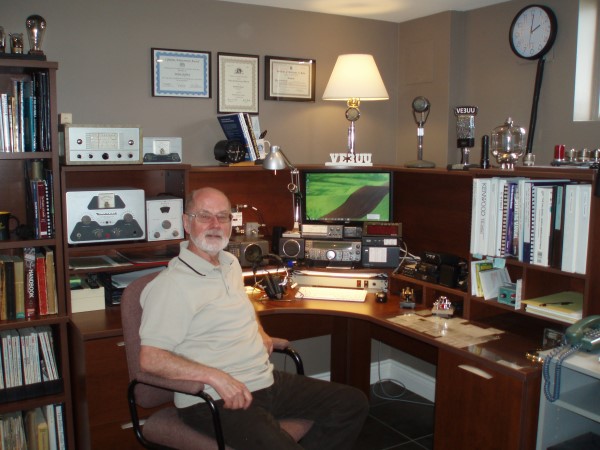
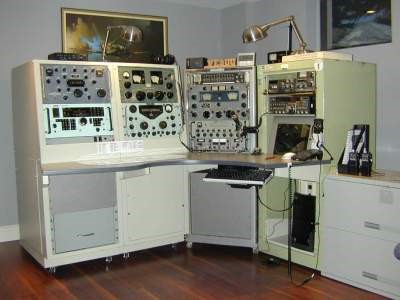
Here is a photo taken in 2004 before I started thinning out some of my boatanchors.

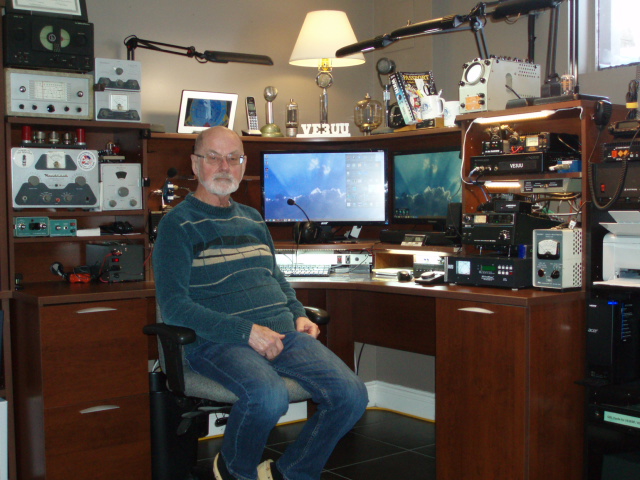
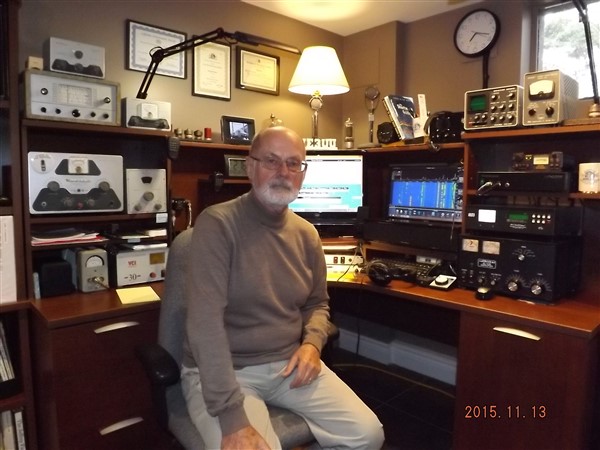
Current photo.

As you can see from the photo I'm an ancient relic surrounded by other ancient relics. I collect boatanchors.


Like many early hams, I was very active in my earlier years but found myself increasingly busy trying to make a living, raise a family, and generally cope with life and I got away from the hobby. Several years ago I made the decision to become active in the hobby once again and that's when I started collecting boatanchor and green (military) radios.

Here's a photo of the repair/restore center for sick radios. The centerpiece of the equipment is an URM-25 signal generator.

Workshop area

As the house began to sink under the weight of my many treasures I decided to weed out what I didn't want, couldn't fix, or would never use. You can check out the Boatanchor Corner below to see what's left in the collection.

Back to top


VE3UU Equipment Line-up

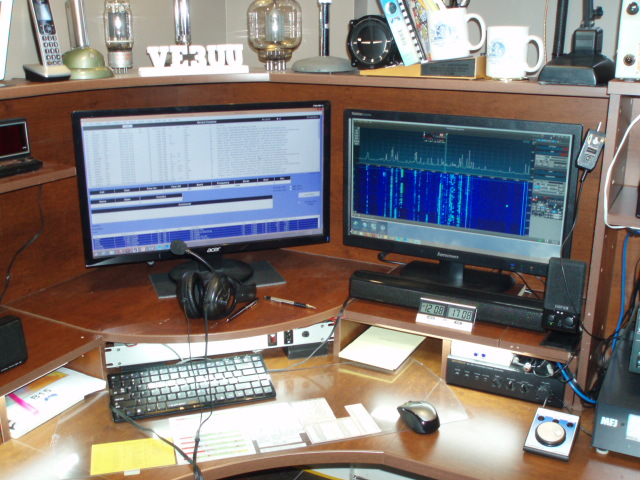
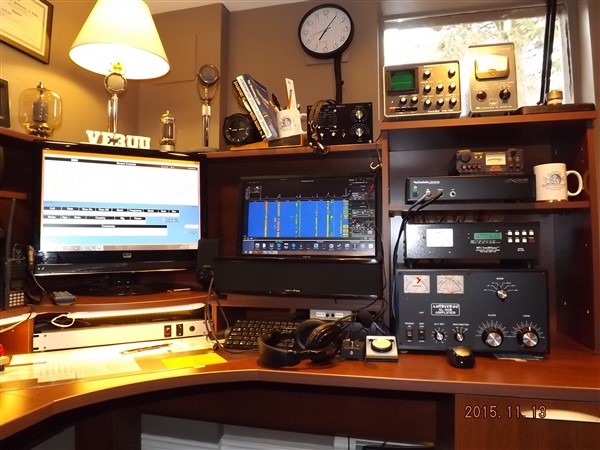
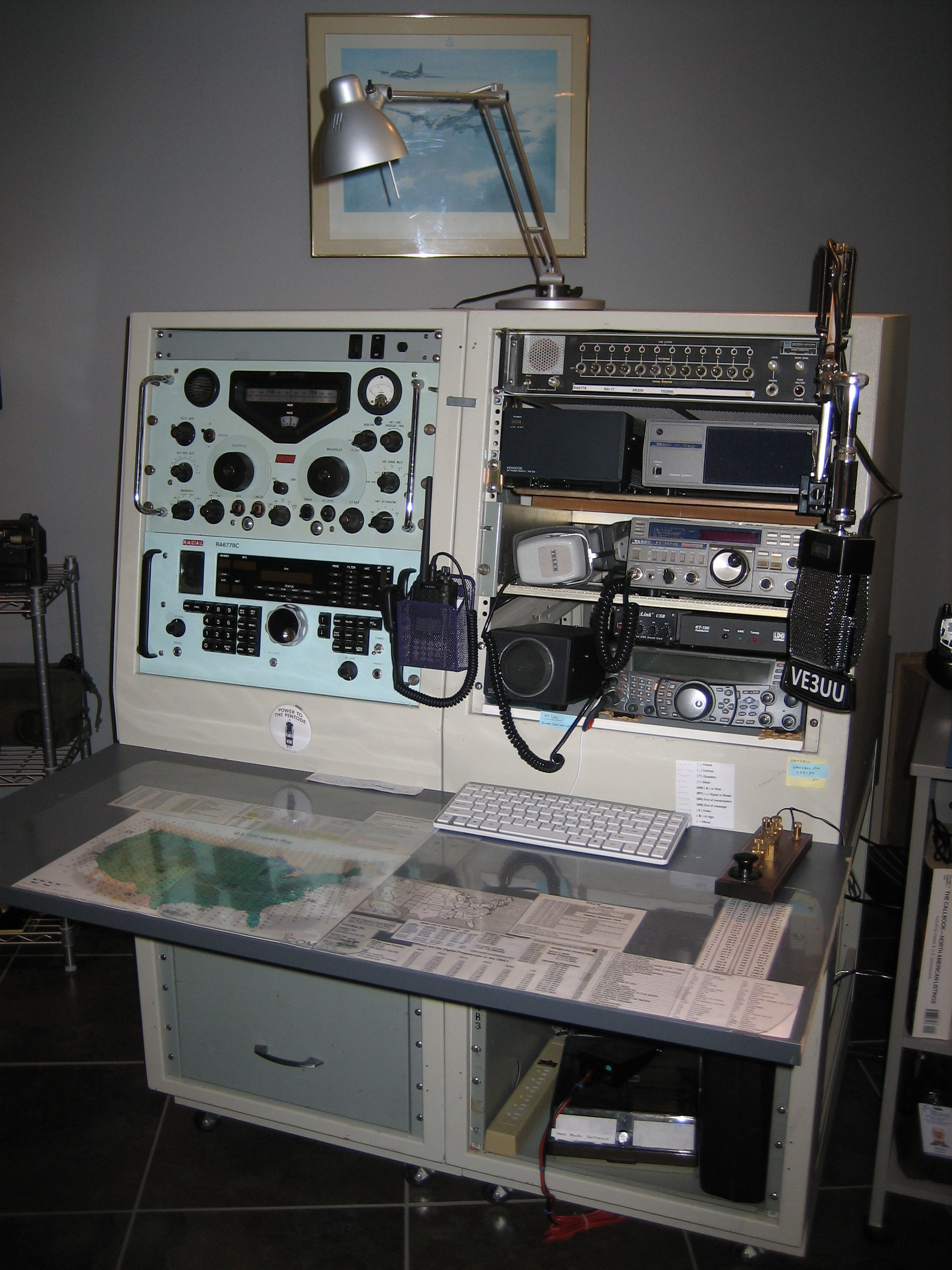
I always wanted a professional looking operating position and over the years I've been able to put together something that I'm proud of. Here is a photo of my current operating console.

VE3UU Operating Position

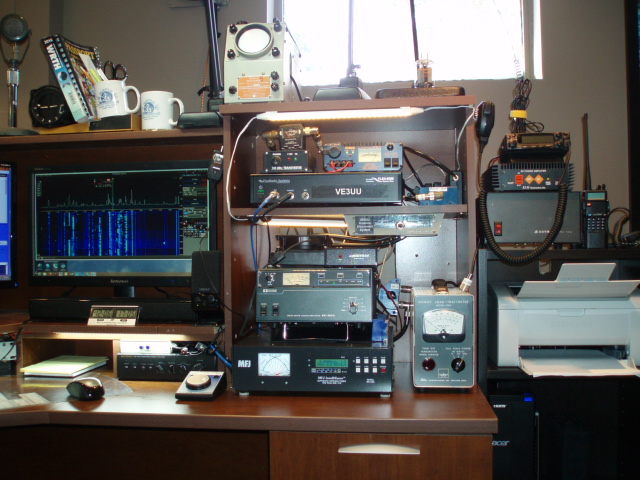
Here are some detailed pictures of the various pieces of equipment that are in the console.

Starting at the top left and going clockwise you have the classic Collins R-390A receiver. This one was made by Imperial Electronics and is serial number 102. The R-390A, unlike the other receivers in this picture is definitely not a band cruiser. At the top right is a Hammarlund SP-600 JX-14 receiver. Underneath is a Racal RA-17 and finally, at the bottom left is a Racal RA-6778C.

Main radios

The picture below show the TMC GPR-90RXD receiver, the Harris RF-505A (definitely not a band cruiser!) and an ACL SR-209 VHF/UHF receiver. The unit at the very top is a Watkins-Johnson Audio Monitor acquired from Fair Radio.

The radios in these two pictures are my prime SWL receivers.

Main radios-2

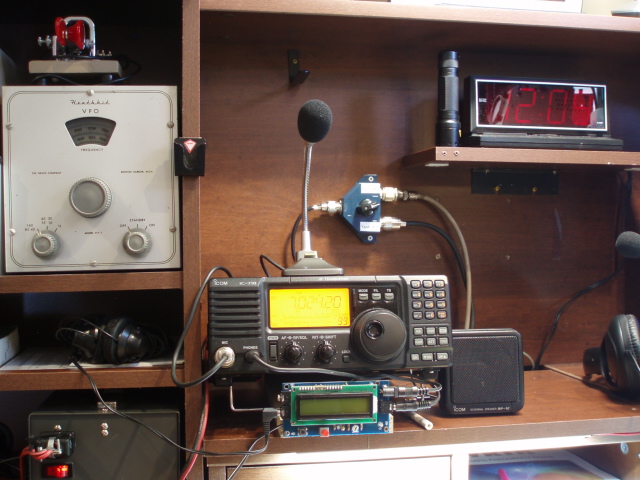
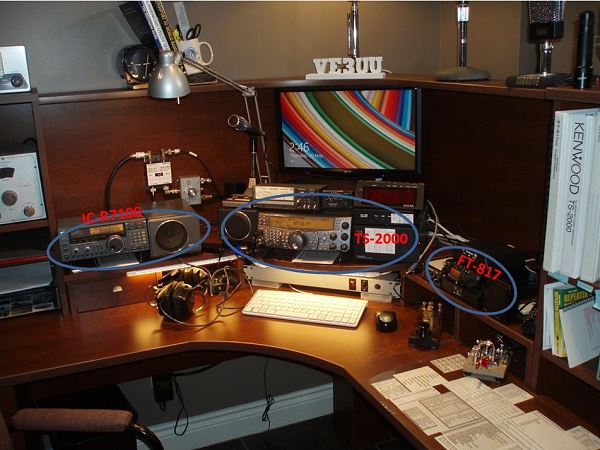
Below is a photo of the VE3UU operating position. The Yaesu FT-767GX is my main transceiver. It is equipped with modules for 6, 2 meters, and 440 Mhz.

The Kenwood TS-120S and AT-200 have been relegated to PSK-31 work and as a standby rig for the Yaesu. Out of sight are a pair of Midland 75-003 handhelds.

Tucked in at the right side of the FT-767 is an ICOM PCR-1000 receiver which provides me with the ability to listen to any frequency from DC to light (well, not quite).

Ham Gear

Back to top


Boatanchor Corner

I was raised and educated in the era of the vacuum tube and always had a love for this type of equipment. After many years away from the hobby, I wanted to ease my way back in so I decided to start a small collection of military and non-military boatanchor radios. Over the past several years boatanchors have come and gone from the collection. Here is a picture of most of my current collection.


Whole BA Collection

Let's take a closer look at some of the equipment in the collection. Starting on the left side (below) you can see the Wireless Set #19, Mk-3 at the top, a Gibson Girl Survival Radio (the yellow unit) on the left, and a Hammarlund SP-200 SuperPro on the bottom. To the right of the Hammarlund is a CPRC-26 and a PRC-6 military transceiver.

Left side of collection

Here is a closer look at the Wireless 19 set.

WS-19 Mk-3

On the right side of the collection you'll find a selection of aircraft radios. On the top is the venerable AN/ART-13 while on the second shelf is a collection of AN/ARC-5 Command sets and a BC-221 Frequency Meter. The bottom shelf holds an TA-312/PT Field Telephone and RT-427/AR-39 Transceiver.

Aircraft radios

Here is a closer look at the ART-13. This unit originally saw service in a PBY and ended up its service years in a Pan American aircraft somewhere.

ART-13

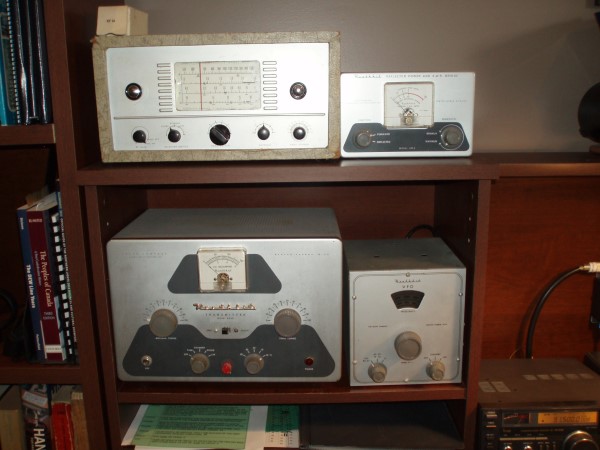
There are a number of other minor pieces of equipment tucked away such as a complete AN/GRC-109 station , some Heathkit gear (a DX-40 and VF-1 combination, memories of my first station in the late 1950's), and some other "green" radios such as a PRC-510, PRC-63, PRT-4 and PRR-9.

Back to top


VE3UU: The Early Years

Here I am with my first major construction project, a Heathkit AR-3 radio. This was the radio that got me started SWLing. The year was 1955 and I was 14-15 years old.

Early BJ picture with AR-3 receiver.

I got my license in 1957 and my first rig was a Heathkit DX-35. I ultimately added a VF-1 VFO and built an 813 grounded-grid linear (the cabinet on the top of my homemade rack). My Mother, bless her heart, bought me a National NC-303 Receiver which I treasured for many years.

First amateur station

The picture below shows me at work. My second job out of school was baby sitting a Ferranti Mark 1 digital computer called FERUT which had been relocated from the University of Toronto to the Structures Laboratory at the National Research Coincil in Ottawa.

Apparently, FERUT was the first electronic digital computer in Canada and the second ever sold in the world after the UNIVAC.

In addition to doing computation work on the AVRO Arrow, FERUT's simulations helped Toronto become the first city in the world to introduce computer controlled traffic lights.

The computer had over 4000 vacuum tubes and my job was to keep it operating. Here I am sitting at the main console. Circa 1958.

FERUT


Back to top


E-Mail